authenticated by

Share
Drinks and Snacks
Immerse yourself in the unique flavors and elaborate cake-making process of Soc Trang pia cake while exploring a land of mixed cultural identities.
Dec 25, 2024 · 7 min read
To create Soc Trang Pia cake, workers must be truly skillful in every stage of production. Therefore, the finished product can touch the hearts of consumers. If you have the opportunity to travel to Soc Trang, you must definitely try this dish.
The image of Pia cake has long been a symbol in the culinary culture of Soc Trang. Not only is it a simple dish, it is also a specialty associated with the traditional craft villages of the people here. Wherever you hear the name of Pia cake, it is a source of pride for a land near the end of the country. In the past, this cake was associated with the traditional Mid-Autumn Festival, but now it is used at almost any time of the year.
The origin of Soc Trang pia cake comes from the Minh Huong people who migrated to our country in the 16th century. They brought with them a cake with the flavor of their homeland when they came here. This dish was once considered the Mid-Autumn Festival cake of the Chaozhou people. Therefore, the name also comes from the Chaozhou language, specifically the word "pia" with the pronunciation "pi-é" translated as cake. In Soc Trang, there is a pia cake making village in Thuan Hoa commune, An Hiep commune, Phu Tam commune, Chau Thanh district. In the past, Soc Trang pia cakes were made entirely by hand. But with the increasing demand as it is now, the processes have had steps made by machines to support productivity.
In 1963, Mr. Tran Cang - a famous Chinese businessman took Pia cakes from Tao Thanh to sell everywhere such as Bien Hoa - Dong Nai, Lai Thieu - Binh Duong. At that time, he saw that these places had a lot of durian, so he brought them back to suggest to the bakery to make Pia cakes with the filling of that fruit. This is also the origin of Pia cakes with green bean and durian filling that many people love.
Address: Phu Tam Commune, Chau Thanh District, Soc Trang Province.
Vung Thom is located about 10km from Soc Trang city, this is considered the birthplace of Soc Trang's pia cake specialty. This dish is about 80 - 100 years old, so it is not strange that it has become a part of the lives of the people here as well as famous throughout the country. Although it originated from the Chinese, through the hands of the Vietnamese people, the dish has a blend and interweave of two cultures. In the past, Chinese families often made this cake to sell to villagers through tea shops, markets, grocery stores, etc.
Some craft villages that still preserve and develop the traditional culture of making Pia cakes in Soc Trang up to now include: Pia cakes from Cong Lap Thanh, Thuan Thanh, My Hiep Thanh, Tan Hue Vien, Tao Thanh,... Among them, Cong Lap Thanh bakery of Mr. Au Minh Xuong is the first. Since he was 9 years old, he has worked as an assistant for a prestigious Pia cake bakery to learn the trade. To remind and preserve the spirit of perseverance in starting a business, he named this place Cong Lap Thanh. Currently, there are many companies and bakeries producing Pia cakes to serve the needs of export markets such as China, the US, Cambodia, Canada,...
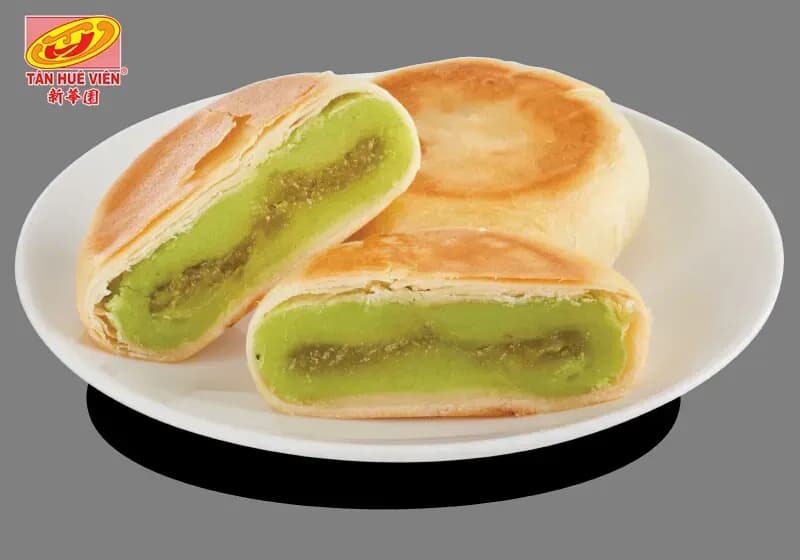
Soc Trang Pia cake has many thin layers of skin stacked on top of each other so that it can be peeled off easily. Therefore, the Southern ethnic people also call this dish peeled skin cake. According to the people who make Soc Trang Pia cake, in the past, the Chinese people made this dish with roasted duck meat, fermented bean curd, lamb fat and pork, the skin was made of millet or wheat flour, then baked over charcoal. After coming to Soc Trang, they gradually processed it to suit the taste of the Vietnamese people and chose ingredients that were easy to find and abundant locally.
Soc Trang Pia cake has an orange-yellow color, small and round shape, so it is convenient and easy to eat. When you take a bite, you will find the quality is beyond expectation, it is not too soft, soft and chewy, does not melt in the mouth immediately. This will be a specialty that many sweet lovers will love.
Usually, those who eat Soc Trang pia cake also choose durian filling because it will create a pure sweet and fragrant flavor that no other flavoring can create. Soc Trang pia cake has two parts: the outer shell made of wheat flour and the filling is Tau xa la or On xa la. Currently, this type of cake has many different types of fillings to satisfy the tastes of diners such as green beans, jam, fat, taro, salted mustard leaves, red beans...
To create a standard Soc Trang pia cake, the artisan must go through many meticulous steps from kneading the dough to grilling. When making the filling, you also need to have separate processing methods for each type. For example, green bean filling needs to be cleaned, taro peeled, cleaned, steamed in a pot and then mashed... The next step is to use the carefully prepared fillings to continue stir-frying with sugar and durian filling in the standard ratio. Let the mixture cool, wrap the filling around each duck egg yolk.
If you want to increase the rich fatty flavor, you can add pork to the filling. Don't worry because the meat will be carefully processed so as not to affect the quality of the cake. Next is a series of rolling and folding operations to create many layers of water dough and oil dough on top of each other. Finally, the baking stage helps the cake to be golden brown with the fragrant smell of durian. This is the type of cake that you can eat forever without getting bored. During the Mid-Autumn Festival, the moon worshiping ceremony, the locals choose this type of cake to enjoy. Because this is the soul of the people of Soc Trang - a land that blends the cultural identities of Kinh, Hoa, and Khmer.
Soc Trang Pia cake brings profit to establishments and production factories in the provincial market and the whole southern region. Restaurants and convenience stores sell many types of Pia cake to serve visitors to the province to buy to eat or as gifts for their families.
In addition, the Soc Trang Pia cake craft village has also helped create a fairly stable source of income for hundreds of households. It is also from the economic benefits it brings that the Soc Trang community is increasingly skilled and produces goods more professionally. The products are increasingly sophisticated and characteristic.
In addition to the Nam Roi Ke Thanh grapefruit, this cake is also receiving attention from local authorities for development.
Specifically, on September 30, 2020, the Department of Culture, Sports and Tourism coordinated with relevant departments to grant the authority to review and the Ministry of Culture, Sports and Tourism issued Decision No. 2728/QD-BVHTTDL to recognize Soc Trang Pia cake and include this dish in the List of national intangible cultural heritage of traditional crafts. With the following statement: "The profession of making Pia cake of the Chinese in Phu Tam commune, Thuan Hoa commune, An Hiep commune, Chau Thanh district, Soc Trang province".
At the same time, the Department of Culture, Sports and Tourism also directed the specialized unit to come here and try to build a Project to Preserve and Promote the Value of this Traditional Craft. Along with this development, production facilities must also know how to improve the quality and process of making cakes according to HACCP standards. In addition, they also apply technical equipment and machinery to increase cake production, but many stages are still done manually.
After nearly 100 years of development, the Pia cake making profession in Soc Trang province in general has had sustainable and outstanding development steps. Soc Trang Pia cake is both delicious and represents a long-standing culture. Therefore, don't forget to save this dish in your travel guide!
Thank you for choosing iGuide.ai to accompany you on your exciting experiences!
Keep reading
 Related
 Related
 Related
 Related
 Related
 Related
 Related
 Related
Log in to leave a comment. Log in
Be the first to comment.
React to this story