authenticated by

Share
Opera Houses
Dec 25, 2024 · 4 min read
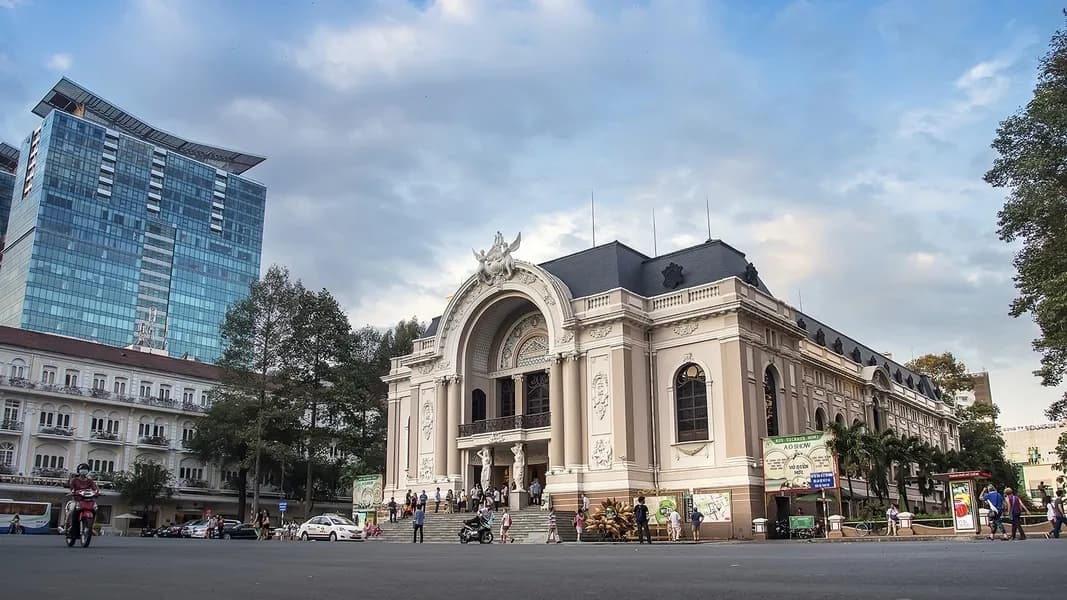
Ho Chi Minh City Opera House (often shortened to City Theater, officially Ho Chi Minh City Symphony Orchestra and Ballet), also known as Saigon Opera House, is a theater with a facade facing Lam Son Square and Dong Khoi Street, District 1, Ho Chi Minh City.
Located in a convenient location in the city center, the theater is considered a central, multi-purpose theater specializing in organizing art performances and is also used to organize major events. This is also a long-standing theater with Western European architecture and is considered a tourist destination of this city. After occupying Cochinchina, in 1863, the French government invited a theater troupe to perform in Saigon to entertain French expeditionary soldiers. At first, the troupe performed temporarily at the wooden house of the Admiral's Palace at Clock Square (Place de l'Horloge) (currently the corner of Nguyen Du - Dong Khoi). Later, a temporary theater was established at the location of the Caravelle Hotel today. In 1898, the Opera House was started right next to the old theater and was inaugurated on January 1, 1900.
Between World War I and World War II, the bringing of the French opera troupe here was entirely subsidized by the city government. Although it was intended to become an entertainment center for the elite, the Western Theater lost more and more visitors, as the partygoers were mostly attracted by nightclubs, restaurants with music and dancing... After its initial period of bustling operation, the theater only operated moderately with singing, concerts and reformed opera. Due to criticism of its cumbersome architecture and high organization costs, the city government once intended to convert the theater into a concert venue (Salle de Concert).
However, this intention was not realized. Instead, in 1943, the decoration and sculptures on the facade of the theater were removed (the statue of the goddess of art, the flower strings, two lamps...) to rejuvenate the architectural style. However, in 1944, the theater was bombed by Allied aircraft, causing serious damage and had to stop operating. After the French reoccupied Indochina, due to the war situation, the theater was not renovated much.
In 1954, this place was used as a temporary residence for French civilians from the North who migrated to the South under the Geneva Agreement in 1954. In 1955, the theater was renovated but was used as the National Assembly Headquarters (later called the House of Representatives) of the Republic of Vietnam government. After 1975, the theater was restored to its original function of organizing art performances. In 1998, on the occasion of the 300th anniversary of the birth of Saigon City, the City Government carried out a major renovation with the motto of preserving the original architectural style, with some decorations and relief sculptures on the facade of the theater such as the statue of the goddess of art, flower strings... being restored. The Ho Chi Minh City People's Council approved a theater renovation project in November 2007, with an estimated budget of 1.6 billion VND. In this program, the architectural restoration components are listed as follows: The project was completed at the end of 2009. The company organizing the cultural performances received a 160,000 € subsidy from the City of Lyon (France) to equip the night-time artistic lighting system.
The Saigon Opera House is an architectural counterpart to the Hanoi Opera House - built in 1911, modeled after the Opéra Garnier in Paris, 900 seats, architect Broger et Harloy. The Saigon Opera House retains its own unique characteristics. The architects of this building are Félix Olivier, Ernest Guichard and Eugène Ferret, built in 1900 in the "flamboyant" architectural style of the Third French Republic. The facade is clearly influenced by the art of the Petit Palais built in the same year in France. The interior design is modern with full equipment for sound and light.
In addition to the ground floor, there are two upper floors with a total of 1,800 seats. All the decorative patterns, facade reliefs and interiors were painted by a famous French artist similar to the models of French theaters in the late 19th century and sent from France. However, the decoration on the facade of the theater also received many criticisms. In the Imperial style (later decorated in the Beaux Arts style, then simplified in the Art Deco style), the theater facade was decorated with many reliefs and reliefs like the City Hall, so it was criticized as being quite cumbersome and confusing. Therefore, in 1943, some of these decorative details were removed to rejuvenate the architectural style.
In 1998, on the occasion of the 300th anniversary of the founding of Ho Chi Minh City, the current government restored its former function as the city theater and restored some decorations such as the statues of two goddesses of art, flower strings, two lamps... during the renovation and upgrading of the theater. The total cost of the restoration was about 25 billion VND at that time. Originally, the flower garden in front of the theater had no statue.
Thank you for choosing iguide.ai to accompany your exciting experience!
Keep reading
 Related
 Related
 Related
By Admin

By Admin

By Admin

By Admin
Log in to leave a comment. Log in
Be the first to comment.
React to this story