authenticated by

Share
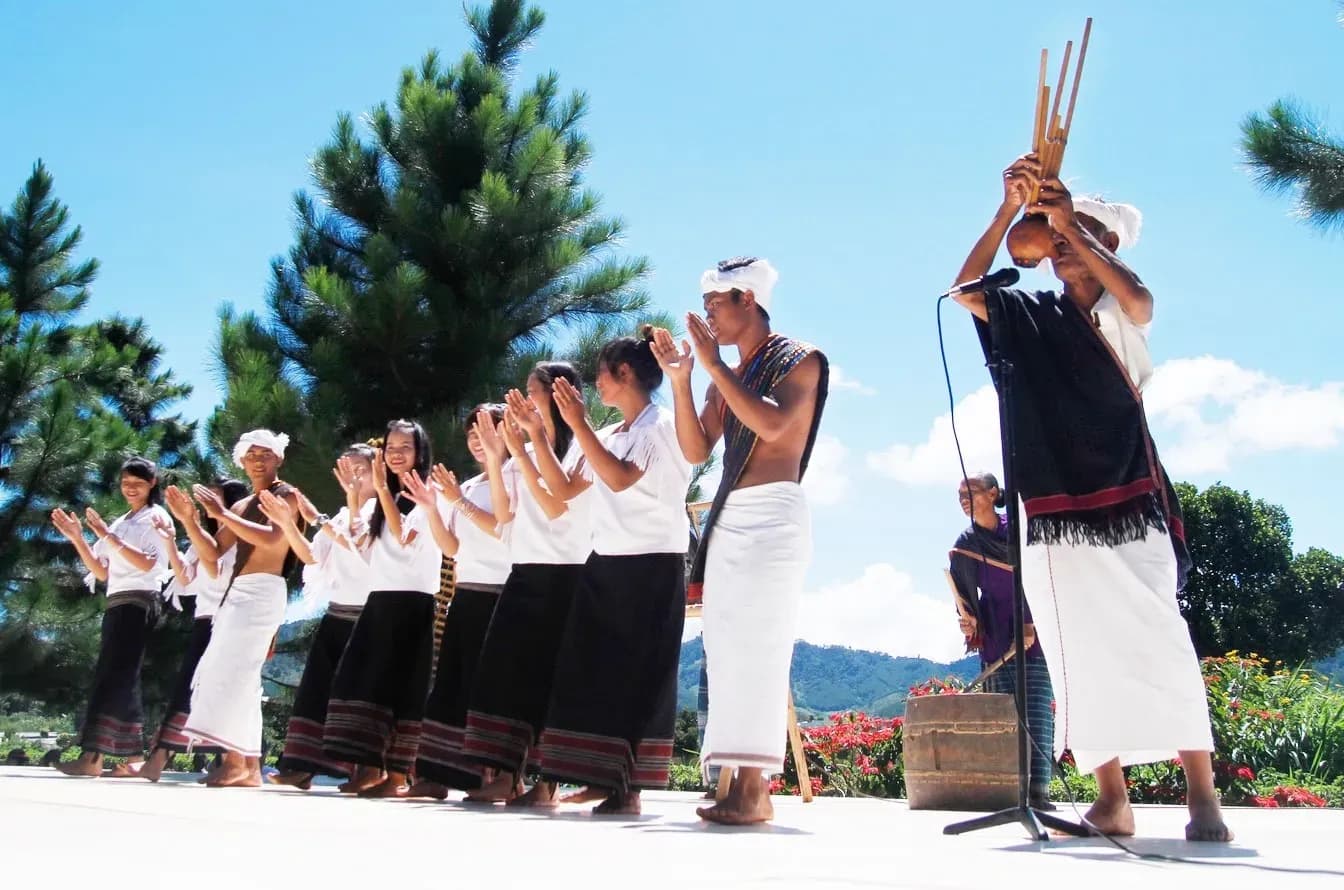
Vietnamese ethnic groups
Be fascinated by the culture and specialties of the Churu ethnic group in Lam Dong. Immerse yourself in their traditional culture and learn about their unique lifestyle.
Dec 25, 2024 · 9 min read
The Churu are one of the ethnic minorities belonging to the Malayo-Polynesian language family in the South, with a relatively small population. With about 10,000 people, the Churu are distributed in Lam Dong, Ninh Thuan and Binh Thuan provinces. Let's find out information about the Churu ethnic group, Vietnam with iGuide.ai!
In Lam Dong, the Churu population is about 8,000 people, concentrated in Tutra commune (Don Duong district), some communes such as Phu Hoi, Loan commune (Duc Trong district) and a few scattered in some communes and hamlets of Di Linh district. In addition, there are about 2,000 people living in the two districts of An Son and Duc Linh of the former Thuan Hai province, now the two provinces of Ninh Thuan and Binh Thuan.
The Churu people speak the Malayo-Polynesian language family. However, due to living in close proximity to the Koho people and having long-standing cultural exchanges, a group of Churu people speak the Koho language of the Mon-Khmer language family.
Up to now, there has been an issue of the relationship between the Churu and the Cham people. According to our actual survey, since ancient times, the Churu and the Cham people may have had a common origin. In terms of language: Churu and Cham both belong to the Malayo-Polynesian language family. If we compare the grammar, phonetics and basic vocabulary, the two languages have a very close relationship. In terms of anthropology, the Churu and the Cham people have similar anthropological characteristics. In terms of traditional beliefs and folklore, we see more and more close relationships.
Due to their historical origins and residential areas, the Churu are a people who have long known how to cultivate rice and live a sedentary life. Cultivation occupies a leading position in economic life and rice is the main food source; in addition, they also grow corn, potatoes, cassava and some vegetables and beans on fields or in gardens. Therefore, of the three main types of cultivation, the most important is the field (hama), followed by the field (apuh) and the garden (poga).
The people often build canals and dams to bring water from rivers and streams to their fields. Building canals, canals, dams and dikes often requires the mobilization of everyone's strength, so each village (plei) of the Churu people usually has a person who specializes in bringing water to the fields, called the head of the water (po Ea).
In addition to agriculture, the Churu people also raise buffalo, cows, pigs, goats, horses and other poultry such as chickens, ducks, geese, etc. Buffaloes and cows are often used as draft animals in agriculture; horses are used to transport goods for exchange with neighboring ethnic groups. Among large livestock, buffaloes are raised more than cows and horses. Because in addition to being used as draft animals, buffaloes are also used in agricultural rituals and traditional beliefs, weddings or used as an equivalent for buying and selling and exchanging within the ethnic group, as well as with other ethnic groups.
Not yet separated from agriculture, hunting, gathering, fishing, the main handicraft products such as: weaving household utensils from rattan and bamboo, and other self-forged tools such as sickles, hoes, grass scrapers, and pottery serving agricultural production and daily life. Especially pottery making, a traditional craft of the Churu people, in villages such as Bkan, Krang Go, Krang Cho... are famous villages for pottery making... However, the crafting techniques are still very primitive. Everyone can participate in pottery making in stages such as: digging soil, kneading soil, etc. Only pottery molding, pottery firing, pottery repair, etc., and other skillful manual technical stages are the work of women.
Weaving here is hardly developed, so most of their traditional costumes such as blankets, shirts, loincloths, yeng, etc. have to be bought and exchanged with neighboring ethnic groups such as the Cham, Koho and Ma people.
In general, the traditional economy of the Churu people is a natural economy, self-sufficient, self-sufficient, limited to each family, clan and village. In these types of economy, cultivation plays a leading role. Animal husbandry has not yet become a main occupation and has not been separated from cultivation. Handicraft is still a secondary occupation in families. In essence, it is still a backward agricultural economy, the commodity economy has not yet developed.
The traditional Churu society was based on the plei (village) organization. A village was a large area of several square kilometers including: residential land, cultivated land, irrigation works along with forests, mountains, rivers and streams and had boundaries (nal) as natural landmarks such as rivers, streams or hills agreed upon by the village heads (po ploi) and thus passed down from generation to generation. Thus, in essence, the land was owned by each family. However, in terms of form, the right to manage traditional land in each clan still belonged to the patriarch (uncle or eldest sister). Before each small family wanted to transfer or sell land, they had to go through the patriarch's opinion and had to have legitimate reasons. In terms of society, a Churu village was often a large clan or a neighboring residential unit. A village included many clans or even people of different ethnicities residing together. For example, Dom A village has two clans: Touneh and B'nahria; Dom B village has three clans: Đơlông, K'bao B'nuh and D'nông Sang, B'kau village has three clans: Crugiang, B'nahria and M'hới. And in all three villages mentioned above, there are Koho and Raglai people living together.
Below the village, there are bloodline communities such as: extended family, sub-family and clan. The family in the traditional Churu society is an extended family that still has many remnants of the matriarchal family system. This is most concentratedly expressed in the role of the wife, the uncle (miăh) and the inheritance rights of the daughters in the family. The extended family of the Churu usually has 3 to 4 generations of children of the same mother and their husbands and children living together under one long roof (sang tơnuh prong). The organization of the extended family is based on the economic, social and ideological community.
The Churu people have always lived in a relatively unified ethnic territory, so they have often had marriage relationships within the ethnic group. However, they still have marriage relationships with other ethnic groups, especially the Koho and Raglai people living nearby, and have a long history of economic, cultural and social exchanges. Especially in recent times, due to the US-puppet policy of concentrating people into strategic hamlets, it has led to a situation of mixed and intermixed residence between these ethnic groups in the same village and hamlet. In particular, there have been a few cases of marriage with Vietnamese people, usually Vietnamese wives and Churu husbands. These were Churu officials during the French period and officers and civil servants during the US-puppet period. The Churu people's marriage system is monogamous and they live with the wife. Women play an active role in marriage, which they often call the custom of "capturing a husband".
Due to the low level of economic and scientific development, people are too dependent on nature, the Churu people still preserve many backward customs and practices. One of those customs is the worship and belief in polytheism. Ancestor worship here originates from their belief in the eternal existence of the souls of the deceased.
The ancestor worship ceremony (Pơkhimocay) here is completely different from the ancestor worship ceremony of the Vietnamese people. The ceremony does not have a specific date and month. It may be held once every two or three years or twenty or thirty years, depending on the economic situation of each family and clan. In the house of the Churu people, there is no altar or memorial tablet for the deceased. They only make an altar and perform the worship on a certain occasion in the cemetery (kotatau) and do not bring it home. Usually, when someone dies, they slaughter a buffalo or cow to perform the ceremony.
This is a long-standing custom that still has a profound influence on the spiritual life of the Churu people. Until the invasion of religions such as Catholicism and Protestantism, followers of these religions still worshiped their ancestors in parallel with the worship of God.
The Churu have a rich repertoire of folk songs and proverbs. Most of them reflect the matriarchal system, emphasizing the role of women in the family and in their traditional society.
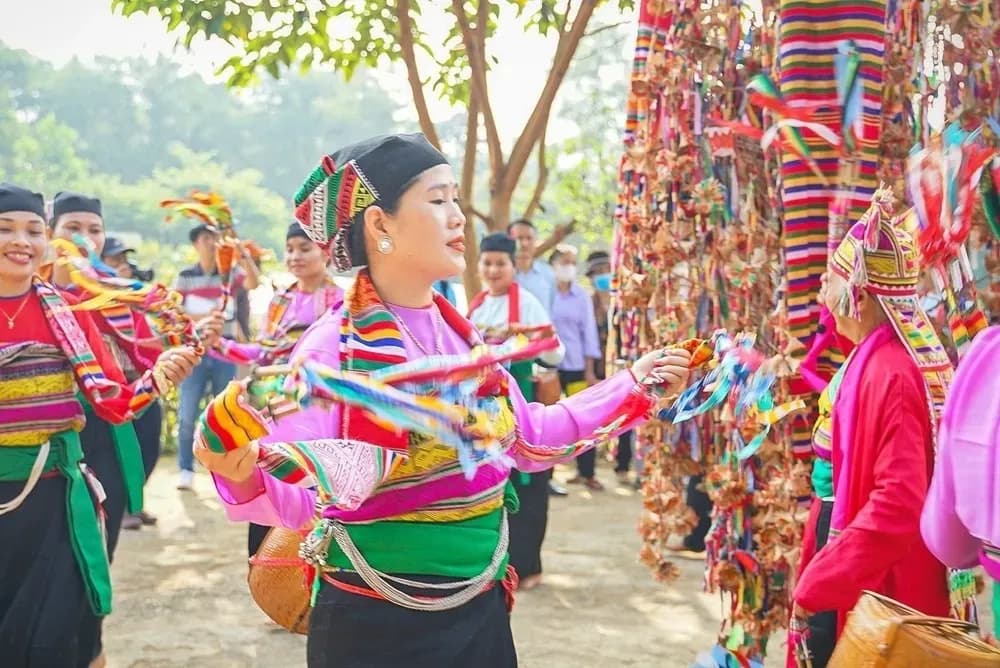
Regarding music, in addition to drums (sơ gôn), trumpets (rôkel), and cymbals (sar), etc., there are also r'tông, kwao, and terlia, which are special musical instruments of the Churu people. On happy days, they often play Tam-ga, a very skillful communal dance that almost everyone knows and loves.
The Churu people, as well as other ethnic minorities in the Central Highlands, have contributed their efforts to the cause of building and defending the socialist Vietnamese Fatherland. Under the feudal colonial regime, the people were repressed in many ways, oppressed and exploited heavily, especially despised and scorned. After the complete liberation of the South, the Churu people's lives truly changed. Under the leadership of the Party, the Churu people have been working side by side with other ethnic groups in the country to build and defend the socialist Vietnamese Fatherland, to build a prosperous and happy life.
Above is some interesting information about the Churu ethnic group in Vietnam. Let's join iGuide.ai to plan a survey, dialogue and integrate with the unique culture of the Churu people in the near future!
Source:
- Ethnic groups in Vietnam (National Political Publishing House Truth)
- Basic characteristics of 54 ethnic minorities in 2019 (Committee on Ethnic Minorities and General Statistics Office)
- Website of Ethnic Committee, Website of Nhan Dan Newspaper, Website of Lam Dong Newspaper
- Survey results collect information on the socio-economic status of 54 ethnic groups in Vietnam)
Log in to leave a comment. Log in
Be the first to comment.
React to this story
Keep reading
 Related
 Related
 Related
 Related
 Related
 Related
 Related
 Related