authenticated by

Share
Vietnamese ethnic groups
Discover the unique culture of the Ta Oi people. Experience the unique history, traditions, and lifestyle of Central Vietnam.
Dec 25, 2024 · 6 min read
The Ta Oi people are a long-standing ethnic group in Truong Son. With a population of more than 50 thousand people, the Ta Oi people still preserve their unique traditional culture and long-standing customs. Let's find out information about the Ta Oi people in Vietnam with iGuide.ai!
Regarding origin, most researchers believe that the Ta Oi people are originally from Laos and migrated to Vietnam several hundred years ago. Some older Ta Oi people believe that the Ta Oi people originated locally. Other names: Ta Oi, Pa Co, Ta Uot, KanTua, Pa Hy... Local groups: Ta Oi, Pa Co, Pa Hy.
According to the survey of 53 ethnic minorities on April 1, 2019, the Ta Oi ethnic group has 52,356 people, the male population is 26,201 people, the female population is 26,155 people, 92.5% of the population lives in rural areas.
Mainly in Dakrong and Huong Hoa districts, Quang Tri province and A Luoi district, Thua Thien Hue province.
Language: Belongs to the Mon-Khmer language group (South Asian language family). Several decades ago, writing was created based on using Latin letters to create a set of rhymes, with Pa Co language as the standard.
Education: According to the survey of 53 ethnic minorities in April 2019, the percentage of Ta Oi people aged 15 and over who can read and write: 78.4%; The percentage of people attending primary school: 99.8%; The percentage of people attending lower secondary school: 83.1%; The percentage of people attending upper secondary school: 52.8%; The percentage of out-of-school children: 17.8%. The percentage of people aged 15 and over who can read and write their own ethnic language: 6.3%.
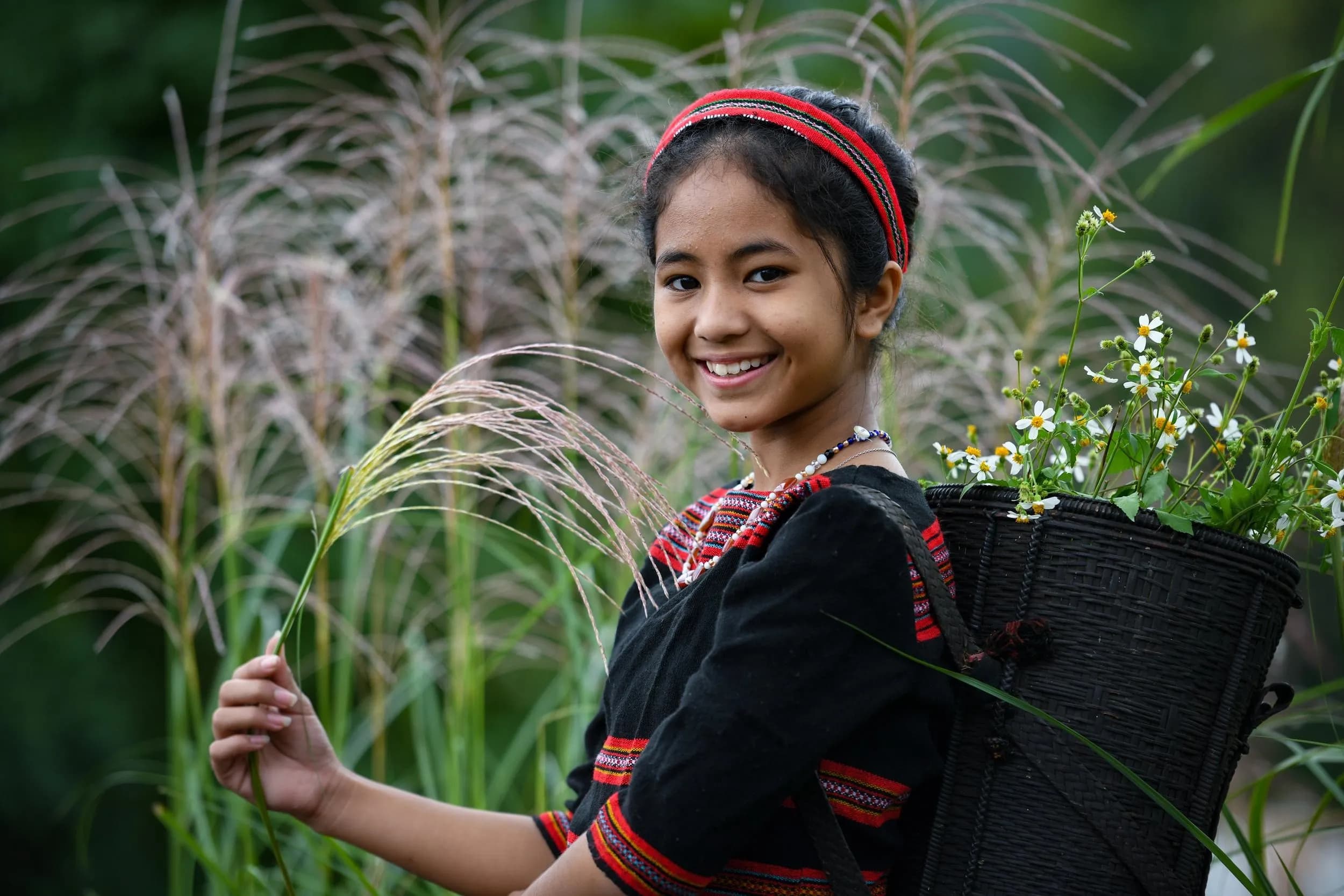
Clothing: Women wear short tube skirts and shirts, or long skirts that cover the chest down. Some places use woven belts, wrap loincloths around their waists and wear shirts. They are often topless. The custom of filing teeth, tattooing the skin, and wearing jewelry that widens the holes in their earlobes is only practiced by a few elderly people.
Housing: The traditional house of the Ta Oi people is a long stilt house, sometimes hundreds of meters long in the past, consisting of many couples and their children (called "kitchens"). There is often a close relationship between the kitchens in the village. The roof is curved at both ends, and on the top of the slope there is a protruding khau cut. Inside the house, each "kitchen" (separate family) has its own living room.
Social relations: The Ta Oi people live according to traditional customs, respect the elderly, believe in the "village elders", and cherish children regardless of gender. Each village consists of people from different clans, each clan has its own leader, taboos and name. The village is the basic and self-governing social unit in traditional society.
Marriage: When boys and girls grow up and have their six upper front teeth amputated, they get to know each other and get married. The marriage is initiated by the groom's family. The bride's family sends their daughter to be the bride and receives dowry including gongs, cymbals, jars, bronze pots, buffaloes, pigs, etc. Some wealthy people have more than one wife.
Funeral: The communal graveyard of the village only buries ordinary dead people. There is a custom of "dividing property" among the dead as in other ethnic groups. Burial after death is temporary. A few years after burial, the bereaved family holds a reburial ceremony, puts the remains in a new coffin and buries them in the graveyard, next to the deceased relatives. At that time, the tomb is beautifully decorated with carvings and paintings.
Worship: The Ta Oi believe that everything has a spirit, from the sky, the earth, mountains, forests, streams, trees to rice, humans, and animals all have "spirits" or souls. Many villages also worship "sacred" objects such as stones, bronze rings, gongs, jars... that are deformed or have strange origins, and are considered to have a mystical relationship to the life of the village.
Festivals: There are many ceremonies related to health, wealth, disease prevention, farming... Major ceremonies all involve buffalo sacrifices and become village festivals. Associated with the farming cycle are important ceremonies to pray to the rice god, hoping for a bountiful harvest and abundance. Traditional Tet falls during the rest period after threshing rice, before the new farming season.
Arts: Proverbs, folk songs, riddles, and ancient stories are quite rich. Folk songs include the Calơi tune for responding when drinking wine or at festivals, the Ba boih tune sung alone while working or on the road, the Roih tune for sending messages and advice to descendants on happy occasions, the Cha chap tune for young people's love...
Musical instruments include many types: gongs, cymbals, buffalo or goat horns, 14-tube bamboo panpipes, 6-hole flutes, two-stringed fiddles that can be played and controlled with the mouth, Ta lu lute...
Slash-and-burn cultivation is the main source of livelihood for the Ta Oi people. The farming method is similar to that of the Co Tu, Bru - Van Kieu ethnic groups. Wet rice fields have developed in many places. In addition to traditional crops, in recent years, the Ta Oi people have also grown some new crops such as coffee, bamboo, rattan, acacia, etc. and switched to raising livestock and poultry, digging ponds to raise commercial fish. The Ta Oi people have long had the craft of weaving zeng (traditional brocade), the products of which are popular with neighboring ethnic groups (especially clothing with lead and white bead patterns). The trade relationship with Laos is also quite important.
According to the survey data of 53 ethnic minorities on April 1, 2019: Rate of poor households: 35.4%; Rate of near-poor households: 14.9%; Unemployment rate: 1.63%; Rate of trained workers with degrees and certificates: 13.5%; Rate of workers working in the non-agricultural sector: 34.3%; Rate of workers working in management or high and medium-level technical and vocational training: 5.3%; Rate of households working in traditional handicrafts: 5.97%.
Above is some interesting information about the Ta Oi ethnic group, Vietnam. Let's plan to explore, meet and experience the culture of the Ta Oi people with iGuide.ai in the near future!
Source:
- Ethnic groups in Vietnam (National Political Publishing House Truth)
- Basic characteristics of 54 ethnic minorities in 2019 (Committee on Ethnic Minorities and General Statistics Office)
- Website of the Ethnic Committee, Website of Nhan Dan Newspaper
- Survey results collect information on the socio-economic status of 54 ethnic groups in Vietnam)
Keep reading
 Related
 Related
 Related
 Related
 Related
 Related
 Related
 Related
Log in to leave a comment. Log in
Be the first to comment.
React to this story