authenticated by

Share
Vietnamese ethnic groups
Meet the unique culture and customs of the La Hu people, from traditional costumes to festivals. Step into the colorful world of this ethnic minority.
Dec 25, 2024 · 5 min read
The La Hu people are a branch of the Dich - Khuong super-tribe that Chinese history books call the Tay Nhung, including the Black La Hu, Yellow La Hu and White La Hu groups. Let's find out information about the La Hu ethnic group in Vietnam with iGuide.ai!
- The La Hu people are a branch of the Dich - Khuong super-tribe that Chinese history books call Tay Nhung, with their origin located in the land between the provinces of Thanh Hai, Cam Tuc, and Sichuan of China today. According to the Lai Chau Provincial Electronic Information Portal, the first La Hu people came to live there only about 10 generations ago.
- La Hu groups include: Black La Hu, Yellow La Hu and White La Hu.
- About the ethnic name: The name La Hu has existed since the Qing Dynasty. According to the List of ethnic groups in Vietnam published in 1979, the name is La Hu.
According to the results of the survey on collecting information on the socio-economic status of 54 ethnic minorities in 2019 by the Vietnam Ethnic Minorities Committee - General Statistics Office, the population of La Hu people as of April 1, 2019 was 12,113 people, of which 6,122 were men and 5,991 were women.
The La Hu people use a language belonging to the Tibeto-Burman language group, belonging to the Sino-Tibetan language family.
The La Hu people live mainly in Muong Te district, Lai Chau province.
In the past, La Hu people's houses were often built scattered on fields and on high mountains in two communes, Pa U and Pa Ve Su, Muong Te district (Lai Chau). The houses were often thatched, when the leaves turned yellow, they moved to another place, so the La Hu people were also called Xa La Vang. Currently, they mainly live in houses on the ground floor or in houses with walls made of earth or planks. The kitchen, the family altar and the family bed are often placed in the same room.
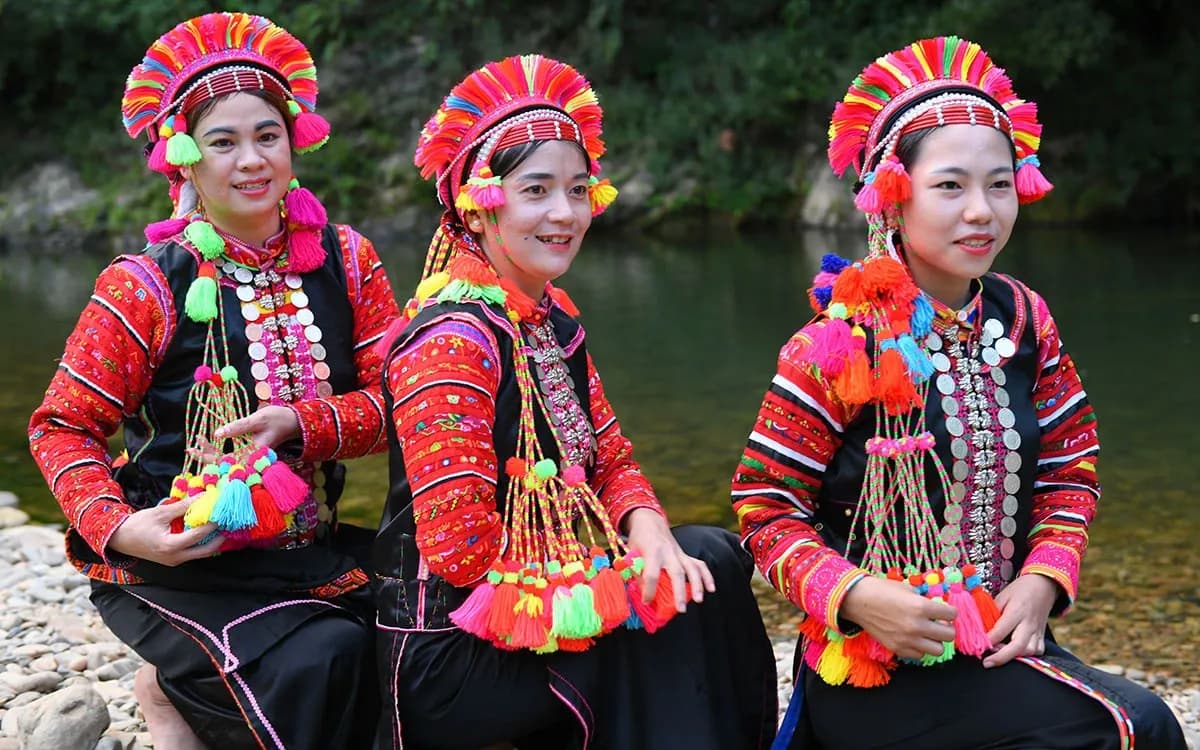
The traditional costume of the La Hu is very diverse. Women wear colorful head scarves, combined with headbands, hats, hair bands, and woolen strings. They wear long-sleeved shirts with round necks embroidered with patterns, with many embroidered details on the body, armpits, and sleeves. Women's pants are made from home-woven fabric dyed indigo black. La Hu men wear simpler costumes, including scarves, shirts, and pants all dyed indigo.
In terms of cuisine, the La Hu mainly eat rice, combined with vegetables, bamboo shoots, and especially tubers such as tapioca, cassava, yam, and yam. They have ways of preserving food such as drying, making pickled bamboo shoots, and drying mushrooms and wood ear mushrooms. Alcohol is an indispensable part of the daily life of the La Hu, especially during holidays, festivals, weddings, and housewarmings. Smoking is also common among both men and women.
The La Hu people's festivals have many interesting characteristics. The traditional Tet (Nhi che che) takes place from the 1st to the 5th of November. After 13 days, on the day of "Nhi che kho" (full moon day), the La Hu people cook banh chung and banh giay. They believe that after the day of Nhi che kho, banh giay must not be pounded. In addition, the La Hu people in some places celebrate Tet on an auspicious day in December or the last day of December, as well as celebrate Tet in the months of March and June, and have a new rice festival held from September to October.
In terms of beliefs, the La Hu people worship their ancestors, grandparents, and deceased parents on holidays and Tet. They only worship ancestors of one generation and call them house ghosts.
The La Hu live mainly by growing upland rice, corn, and cassava, combined with raising cattle, pigs, and poultry. They also exploit natural resources through hunting, gathering, and fishing. In addition, handicrafts such as basketry and weaving are also quite popular.
According to the "Basic characteristics of 54 ethnic minorities in 2019" of the Ethnic Committee and the General Statistics Office, the poverty rate: 74.4%; the near-poor household rate: 3.1%; the unemployment rate: 1.51%; the rate of trained workers with degrees and certificates: 1.7%; the rate of workers working in the non-agricultural sector: 3.0%; the rate of workers working in management or high and medium-level technical and vocational training: 0.7%; the rate of households working in traditional handicrafts: 0.30%.
According to the "Basic characteristics of 54 ethnic minorities in 2019" conducted by the Ethnic Committee and the General Statistics Office, the rate of people aged 15 and over who can read and write: 46.9%; The rate of people attending primary school: 101.9%; The rate of people attending lower secondary school: 77.9%; The rate of people attending upper secondary school: 21.3%; The rate of out-of-school children: 22.1%.
Above is some interesting information about the La Hu ethnic group, Vietnam. Let's join iguide.ai to plan to explore, meet and experience the culture with the La Hu people in the near future!
Source:
- Ethnic groups in Vietnam (National Political Publishing House Truth)
- Basic characteristics of 54 ethnic minorities in 2019 (Committee on Ethnic Minorities and General Statistics Office)
- Website of the Ethnic Committee, Website of Nhan Dan Newspaper
- Survey results collect information on the socio-economic status of 54 ethnic groups in Vietnam)
Keep reading
 Related
 Related
 Related
 Related
 Related
 Related
 Related
 Related
React to this story
Log in to leave a comment. Log in
Be the first to comment.